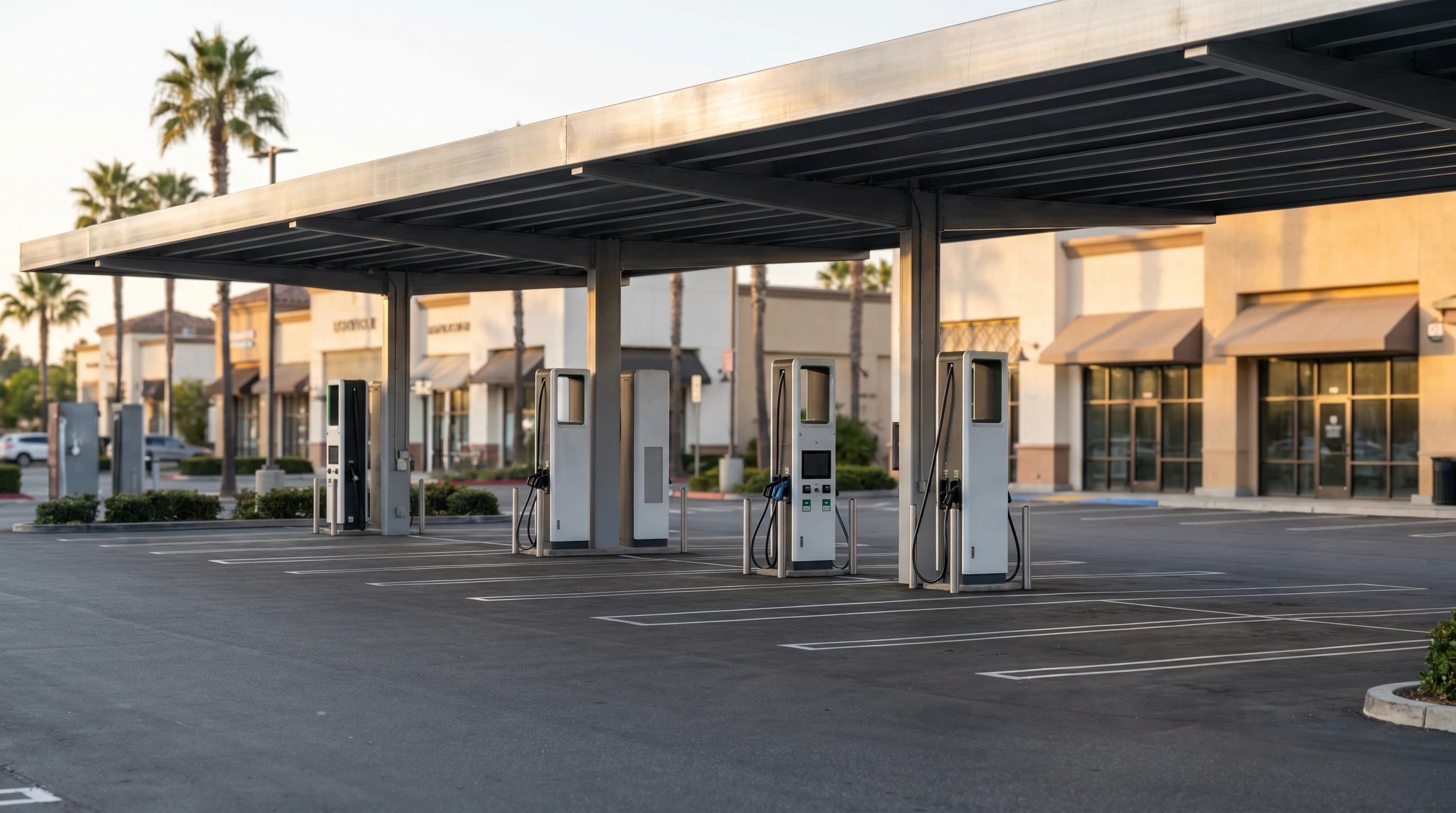
DC Fast Charging (DCFC) Installation for Commercial Properties
DC Fast Chargers deliver rapid charging for high-traffic commercial locations.
Rapid Charging for High-Traffic Commercial Properties
DC fast charging (Level 3) delivers 100–300 miles of range in 20–40 minutes — the right solution for commercial locations where customers and drivers need meaningful charge in a short stop. Unlike Level 2, which requires a 2–6 hour dwell, DCFC serves high-traffic, short-dwell property types that Level 2 can't.
DCFC is a significantly larger infrastructure investment than Level 2 — utility coordination, switchgear, and equipment costs are substantially higher. It's the right investment for the right property type. For most multifamily and long-dwell retail, Level 2 remains the better fit. We help you determine which technology is right during the site assessment.
TECHNICAL SPECIFICATIONS
| Current type | DC (Direct Current) |
| Output per port | 24 kW – 350 kW |
| Range in 30 min | 100 – 300 miles |
| Connector standards | CCS / NACS / CHAdeMO |
| Typical dwell | Under 45 minutes |
| Demand management | Required — built-in or external |
| Network options | ChargePoint, EVgo, Blink, EV Connect |
Full-Scope DCFC Installation
DC fast charging requires more coordination than Level 2 — utility infrastructure, transformer capacity, and demand management must all be addressed before equipment is installed. We manage the entire process.
- Utility coordination and capacity study — existing service evaluation and SCE pre-application
- Transformer and switchgear assessment — upgrade requirements and specifications
- Conduit, switchboard, and civil infrastructure installation
- DCFC equipment mounting and weatherproofing
- Network commissioning and cloud platform setup
- Demand charge management configuration and testing
- Permit filing with local jurisdiction — all filings handled by Gorgen
- Final inspection, utility interconnection, and project documentation
Level 2 vs DC Fast Charging
| Level 2 | DC Fast Charging | |
|---|---|---|
| Dwell time fit | 2+ hours | Under 45 minutes |
| Output per port | 7.2–19.2 kW | 24–350 kW |
| Installation cost | $2,500–$20,000+ | $25,000–$100,000+ |
| Utility complexity | Low–moderate | High (often requires upgrade) |
| Best property type | Multifamily, office, retail | High-traffic retail, fleet, highway |
Not sure which is right for your property? Our free site assessment includes a technology recommendation based on your dwell time patterns, traffic volume, and electrical capacity.
DCFC Incentives — California Stacks to Your Benefit
Inland Empire commercial properties can stack three major incentive programs — in many cases reducing the effective cost of installation to near zero.
SCE Charge Ready
Make-ready infrastructure: trenching, conduit, panel upgrades, and electrical wiring to charger location.
For qualifying properties in SCE territory. Zero out-of-pocket for infrastructure.
CALeVIP Rebate
Per-charger rebate on Level 2 and DC fast charging equipment installed at commercial properties.
Stackable with SCE Charge Ready and federal tax credits.
30C Tax Credit
30% of total equipment and installation costs for commercial EV charging property.
For qualifying commercial properties and businesses. Consult your tax advisor.
Incentive eligibility depends on property type, location, and project scope. Contact us for a free assessment — we identify all programs you qualify for as part of every project.
Where DCFC Makes the Most Sense
Shopping Centers
High-traffic retail anchors benefit from DCFC as a customer draw — EV drivers route to destinations with charging. Demand charge management is essential at retail to protect operating economics.
Fleet Staging Areas
Commercial fleets need rapid turnaround between shifts. DCFC can charge a delivery van or fleet vehicle in 20–40 minutes — compatible with driver break schedules. Load management staggers charging across the fleet.
Gas Station Conversions
Gas stations are ideal DCFC sites: high-traffic corridors, short dwell expectations, existing utility infrastructure. NEVI funding is available for highway-adjacent sites meeting coverage gap criteria.
DC Fast Charging Installation — Cities We Serve
Ready to Install DC Fast Charging at Your Property?
Tell us about your property and we'll schedule a free site assessment. No commitment required.
Get a Free Site AssessmentCommon Questions About DC Fast Charging
Commercial DCFC installation typically ranges from $25,000 to $100,000+ per station, depending on power output, utility infrastructure requirements, and site conditions. The largest cost variable is often the utility upgrade — if your property lacks adequate electrical service, transformer upgrades and switchgear can add $30,000–$100,000 to project costs. California incentives significantly offset this: CALeVIP provides up to $5,000 per DCFC port, and the federal 30C tax credit covers 30% of total equipment and installation costs. We provide a detailed line-item estimate after the site assessment.
50 kW DCFC adds roughly 100–150 miles in 30 minutes and suits smaller retail stops or locations with a 20–30 minute dwell. 150 kW units deliver 200–300 miles in 30 minutes and are the current commercial standard for shopping centers and destination charging. 350 kW is appropriate for high-volume highway corridors or fleet staging areas where maximum throughput matters. For most Inland Empire retail and commercial applications, 50–150 kW is the right range. We size the system based on your expected traffic, dwell time, and utility capacity.
Often yes. A single 150 kW DCFC requires roughly 225A at 480V three-phase service — more than many commercial properties have available as spare capacity. We evaluate your existing utility service, transformer capacity, and main switchgear during the site assessment. If an upgrade is required, we coordinate directly with SCE on the service application and timeline. Utility coordination is the longest part of the DCFC project timeline — starting early is critical.
Demand charges are a utility billing component based on your peak power draw in a given billing period. A 150 kW DCFC operating at full output can spike your monthly demand charge by thousands of dollars — potentially more than the revenue the charger generates. Demand charge management software limits peak draw, staggers charging sessions, and in some configurations uses battery storage to smooth the demand curve. For any DCFC installation, demand charge management is essential — it can reduce monthly utility costs by 30–50% compared to unmanaged operation.
As of 2024, CCS (Combined Charging System) and NACS (the Tesla standard, now adopted by most major automakers) are the two dominant standards in the US. CHAdeMO, once common for Nissan Leaf and Mitsubishi vehicles, is declining rapidly. Modern commercial DCFC equipment typically offers CCS as standard and NACS via adapter or dual-port configuration. We recommend units with CCS + NACS compatibility to maximize the vehicles your chargers can serve now and over the next 5–10 years.
Yes to all three. CALeVIP provides up to $5,000 per DCFC port for qualifying commercial properties — a higher tier than the $3,500 for Level 2. SCE Charge Ready covers make-ready infrastructure (utility coordination, switchgear, conduit) for DCFC in SCE territory. The federal 30C Alternative Fuel Vehicle Refueling Property Credit covers 30% of total DCFC equipment and installation costs, up to $100,000 per charger. For highway-adjacent properties, NEVI funding may also apply. We identify and apply for every program you qualify for.
DC fast charging projects typically take 4–6 months from signed contract to energized chargers — significantly longer than Level 2 (6–12 weeks). The extended timeline is driven by utility coordination: if a transformer upgrade or new service drop is required, SCE lead times alone can run 8–16 weeks. We start utility coordination immediately after project kick-off to compress the overall schedule. Permitting, equipment procurement, and civil work run in parallel with the utility process where possible.
Other Services We Offer
Ready to Add EV Charging to Your Property?
Tell us about your property and we'll schedule a free site assessment. No commitment required.
- Commercial-grade Level 2 and DC fast charger installation
- SCE Charge Ready eligible — $0 make-ready cost for qualifying properties
- Federal 30C tax credit covers 30% of installation costs
- Licensed C-10 Electrical Partners, EVITP certified, fully insured
- Serving all of Riverside and San Bernardino Counties