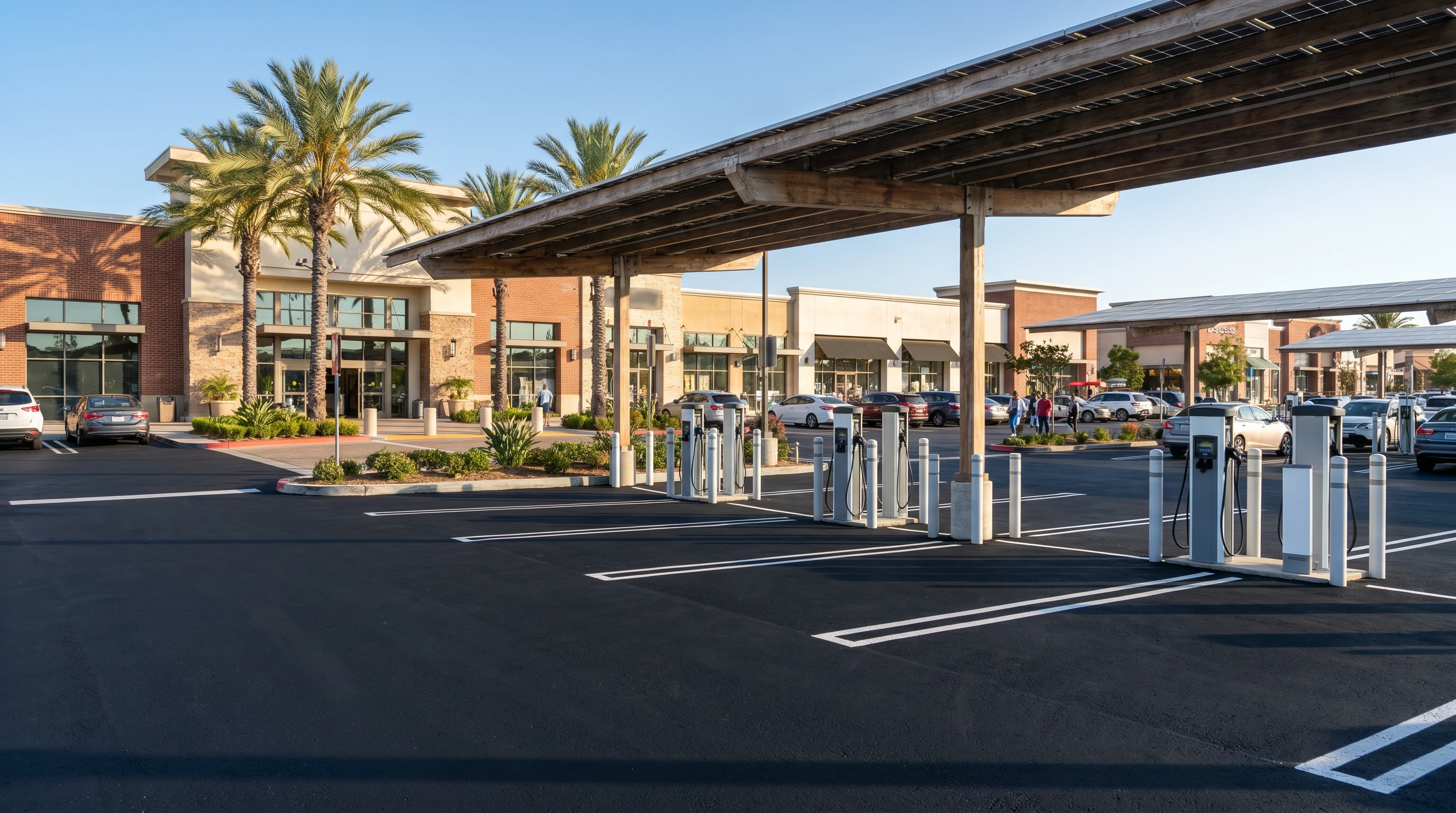
EV Charging for Shopping Centers & Retail Properties
EV drivers spend more and stay longer. Gorgen installs Level 2 and DC fast chargers for shopping centers, strip malls, and retail plazas across the Inland Empire — with full permitting and SCE incentive coordination.
2–6 hr
average retail dwell time — ideal for Level 2
30%
federal tax credit on hardware and installation
$3,500
CALeVIP rebate per Level 2 charger
20×
EV infrastructure gap nationally by 2030
Why EV Charging Matters for Shopping Centers & Retail
Shopping centers and retail plazas in the Inland Empire are watching a competitive dynamic shift in real time: properties with EV charging are attracting a growing segment of high-spending EV drivers, while properties without it are becoming less relevant to a customer base that's changing faster than most owners anticipated. California leads the nation in EV adoption, and the Inland Empire is one of the fastest-growing EV markets in the state.
The retail case for EV charging is simple: your customers are already there for 2–6 hours. Level 2 chargers deliver 50–100 miles of range during a normal shopping visit — enough to meaningfully serve EV drivers without the significant infrastructure cost of DC fast charging. And for high-traffic centers where rapid charging is the draw, we install DCFC systems with demand charge management to protect your economics.
COMMON CHALLENGES
Competing properties are adding charging
EV charging is becoming a differentiator in retail real estate. Tenants and customers are actively choosing between properties — and charging is increasingly a factor in that decision.
DCFC vs Level 2 decision is not obvious
Most retail properties are better served by Level 2 than DCFC — but the right answer depends on dwell time, traffic volume, and utility capacity. Getting this wrong means either over-investing or under-serving.
Demand charges on DCFC can erode economics
DC fast chargers draw significant power in short bursts, which can trigger high demand charges on your utility bill. Without demand charge management, DCFC operating costs can be punishing.
Permit coordination requires local expertise
Retail EV charger permits involve the city building department and SCE utility coordination. Managing this across multiple agencies requires experience with local Inland Empire processes.
The California Incentive Stack
Inland Empire commercial properties can stack three major incentive programs — in many cases reducing the effective cost of installation to near zero.
SCE Charge Ready
Make-ready infrastructure: trenching, conduit, panel upgrades, and electrical wiring to charger location.
For qualifying properties in SCE territory. Zero out-of-pocket for infrastructure.
CALeVIP Rebate
Per-charger rebate on Level 2 and DC fast charging equipment installed at commercial properties.
Stackable with SCE Charge Ready and federal tax credits.
30C Tax Credit
30% of total equipment and installation costs for commercial EV charging property.
For qualifying commercial properties and businesses. Consult your tax advisor.
Incentive eligibility depends on property type, location, and project scope. Contact us for a free assessment — we identify all programs you qualify for as part of every project.
Our Process for Retail Properties
01
Site Assessment & Technology Selection
We evaluate your dwell time patterns, electrical capacity, and parking layout to determine whether Level 2, DCFC, or a combination is right for your center. Most retail properties are best served by Level 2.
02
Permit & Utility Coordination
We file building permits and coordinate SCE utility work in parallel to compress your project timeline. DCFC projects require SCE service evaluation and may require a transformer upgrade — we manage this end-to-end.
03
Installation & Network Setup
Equipment is installed, networked, and commissioned. We configure your preferred billing model — pay-per-use, validated parking, or tenant-included — and ensure the system is live and monitored from day one.
Get EV Charging for Your Retail Property
We handle everything from site assessment to installation — and help you maximize every available incentive.
Get a Free Site AssessmentCommon Questions
For most shopping centers and retail plazas, Level 2 is the right choice. Customers typically dwell 2–6 hours — long enough for a Level 2 charger to add 50–100 miles of range. Level 2 installation is significantly less complex and less expensive than DCFC, and doesn't trigger the demand charge management requirements that come with fast charging. DCFC makes sense for very high-traffic centers or locations near highway corridors. We'll help you make the right call during your free site assessment.
Most retail properties use a paid model (by the kWh or by the session) through a charging network operator. This offsets operating costs and is the industry standard at commercial shopping centers. Some anchor tenants offer free charging as a customer retention tool, but this requires a clear ROI model to justify the ongoing electricity cost. We can walk through both models based on your tenant mix, customer profile, and operating cost tolerance.
CALeVIP provides up to $3,500 per Level 2 charger and up to $5,000 per DCFC port for qualifying commercial properties. Shopping centers in SCE territory are eligible. Applications are submitted through the CALeVIP program portal, and funding is awarded on a first-come, first-served basis when rounds open. We help you identify eligibility, prepare documentation, and time your application to coincide with open funding rounds.
Under California AB 1236, local jurisdictions must approve EV charger permits within 20 business days of receiving a complete application. Most Inland Empire cities comply with this timeline. We handle all permit preparation and filing. Utility coordination with SCE typically adds 2–4 weeks to the overall project timeline.
Demand charges are a utility billing component based on your peak power draw in a given month. A 150 kW DC fast charger drawing full power can spike your demand charges significantly — sometimes adding thousands of dollars per month to your utility bill. Demand charge management software limits peak draw, staggers charging sessions, and in some cases uses battery storage to flatten the demand curve. For any DCFC installation, demand charge management is not optional — it's essential for the economics to work.
Other Services We Offer
Ready to Add EV Charging to Your Property?
Tell us about your property and we'll schedule a free site assessment. No commitment required.
- Commercial-grade Level 2 and DC fast charger installation
- SCE Charge Ready eligible — $0 make-ready cost for qualifying properties
- Federal 30C tax credit covers 30% of installation costs
- Licensed C-10 Electrical Partners, EVITP certified, fully insured
- Serving all of Riverside and San Bernardino Counties